KPLS
KPLS is a kriging model that uses the partial least squares (PLS) method. KPLS is faster than kriging because of the low number of hyperparameters to be estimated while maintaining a good accuracy. This model is suitable for high-dimensional problems due to the kernel constructed through the PLS method. The PLS method [1] is a well known tool for high-dimensional problems that searches the direction that maximizes the variance between the input and output variables. This is done by a projection in a smaller space spanned by the so-called principal components. The PLS information are integrated into the kriging correlation matrix to scale the number of inputs by reducing the number of hyperparameters. The number of principal components \(h\) , which corresponds to the number of hyperparameters for KPLS and much lower than \(nx\) (number of dimension of the problem), usually does not exceed 4 components:
Both absolute exponential and squared exponential kernels are available for KPLS model. More details about the KPLS approach could be found in these sources [2].
For an automatic selection of the number of components \(h\), the adjusted Wold’s R criterion is implemented as detailed in [3].
Usage
import matplotlib.pyplot as plt
import numpy as np

from smt.surrogate_models import KPLS

xt = np.array([0.0, 1.0, 2.0, 3.0, 4.0])
yt = np.array([0.0, 1.0, 1.5, 0.9, 1.0])

sm = KPLS(theta0=[1e-2])
sm.set_training_values(xt, yt)
sm.train()

num = 100
x = np.linspace(0.0, 4.0, num)
y = sm.predict_values(x)
# estimated variance
# add a plot with variance
s2 = sm.predict_variances(x)
# to compute the derivative according to the first variable
_dydx = sm.predict_derivatives(xt, 0)

plt.plot(xt, yt, "o")
plt.plot(x, y)
plt.xlabel("x")
plt.ylabel("y")
plt.legend(["Training data", "Prediction"])
plt.show()

plt.plot(xt, yt, "o")
plt.plot(x, y)
plt.fill_between(
    np.ravel(x),
    np.ravel(y - 3 * np.sqrt(s2)),
    np.ravel(y + 3 * np.sqrt(s2)),
    color="lightgrey",
)
plt.xlabel("x")
plt.ylabel("y")
plt.legend(["Training data", "Prediction", "Confidence Interval 99%"])
plt.show()
___________________________________________________________________________

                                   KPLS
___________________________________________________________________________

 Problem size

      # training points.        : 5

___________________________________________________________________________

 Training

   Training ...
   Training - done. Time (sec):  0.0968523
___________________________________________________________________________

 Evaluation

      # eval points. : 100

   Predicting ...
   Predicting - done. Time (sec):  0.0002611

   Prediction time/pt. (sec) :  0.0000026

___________________________________________________________________________

 Evaluation

      # eval points. : 5

   Predicting ...
   Predicting - done. Time (sec):  0.0003815

   Prediction time/pt. (sec) :  0.0000763
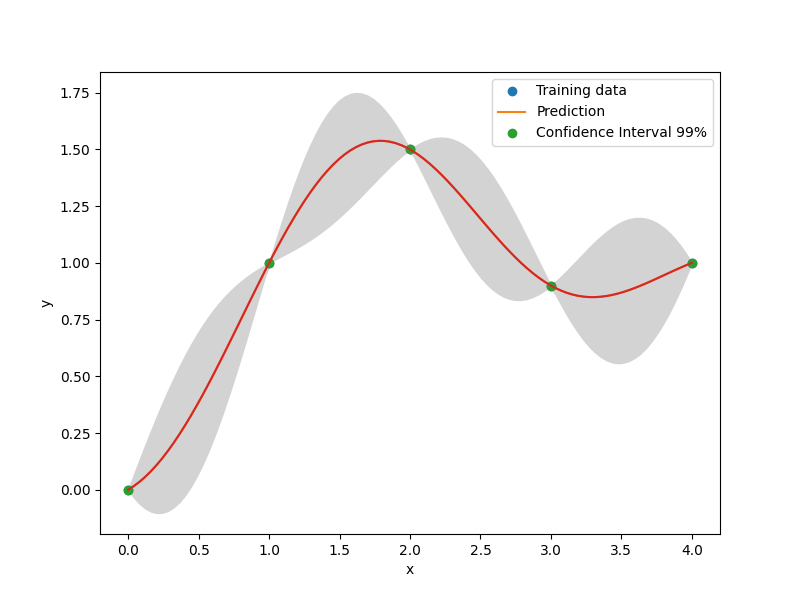
Usage with an automatic number of components
import numpy as np

from smt.problems import TensorProduct
from smt.sampling_methods import LHS
from smt.surrogate_models import KPLS

# The problem is the exponential problem with dimension 10
ndim = 10
prob = TensorProduct(ndim=ndim, func="exp")

sm = KPLS(
    eval_n_comp=True,
    eval_n_comp_strategy="wold",
)
samp = LHS(xlimits=prob.xlimits, seed=42)
xt = samp(50)
yt = prob(xt)
sm.set_training_values(xt, yt)
sm.train()

## The model automatically choose a dimension of 5
ncomp = sm.options["n_comp"]
print("\n The model automatically choose " + str(ncomp) + " components.")

## You can predict a 10-dimension point from the 3-dimensional model
print(
    sm.predict_values(
        np.array([[-0.9, -0.7, -0.5, -0.3, -0.1, 0.1, 0.3, 0.5, 0.7, 0.9]])
    )
)
print(
    sm.predict_variances(
        np.array([[-0.9, -0.7, -0.5, -0.3, -0.1, 0.1, 0.3, 0.5, 0.7, 0.9]])
    )
)
___________________________________________________________________________

                                   KPLS
___________________________________________________________________________

 Problem size

      # training points.        : 50

___________________________________________________________________________

 Training

   Training ...
   Training - done. Time (sec): 87.2217591

 The model automatically choose 5 components.
___________________________________________________________________________

 Evaluation

      # eval points. : 1

   Predicting ...
   Predicting - done. Time (sec):  0.0002754

   Prediction time/pt. (sec) :  0.0002754

[[2.73415724]]
[[40.38142747]]
Usage with a range of number of components
import numpy as np

from smt.problems import TensorProduct
from smt.sampling_methods import LHS
from smt.surrogate_models import KPLS

# The problem is the exponential problem with dimension 10
ndim = 10
prob = TensorProduct(ndim=ndim, func="exp")

n_comp_range = [2, 6]  # We explore the range [1, 5] n_dim and we chose the best

sm = KPLS(
    eval_n_comp=True,
    eval_n_comp_strategy="exhaustive",
    range_n_comp_exhaustive=n_comp_range,
)
samp = LHS(xlimits=prob.xlimits, seed=42)
xt = samp(50)
yt = prob(xt)
sm.set_training_values(xt, yt)
sm.train()

## The model automatically choose a dimension of 5
ncomp = sm.options["n_comp"]
print("\n The model automatically choose " + str(ncomp) + " components.")

## You can predict a 10-dimension point from the 3-dimensional model
print(
    sm.predict_values(
        np.array([[-0.9, -0.7, -0.5, -0.3, -0.1, 0.1, 0.3, 0.5, 0.7, 0.9]])
    )
)
print(
    sm.predict_variances(
        np.array([[-0.9, -0.7, -0.5, -0.3, -0.1, 0.1, 0.3, 0.5, 0.7, 0.9]])
    )
)
___________________________________________________________________________

                                   KPLS
___________________________________________________________________________

 Problem size

      # training points.        : 50

___________________________________________________________________________

 Training

   Training ...
   Training - done. Time (sec): 59.3835318

 The model automatically choose 5 components.
___________________________________________________________________________

 Evaluation

      # eval points. : 1

   Predicting ...
   Predicting - done. Time (sec):  0.0003910

   Prediction time/pt. (sec) :  0.0003910

[[2.73416137]]
[[40.38140393]]
Options
Option |
Default |
Acceptable values |
Acceptable types |
Description |
|---|---|---|---|---|
print_global |
True |
None |
[‘bool’] |
Global print toggle. If False, all printing is suppressed |
print_training |
True |
None |
[‘bool’] |
Whether to print training information |
print_prediction |
True |
None |
[‘bool’] |
Whether to print prediction information |
print_problem |
True |
None |
[‘bool’] |
Whether to print problem information |
print_solver |
True |
None |
[‘bool’] |
Whether to print solver information |
poly |
constant |
[‘constant’, ‘linear’, ‘quadratic’] |
[‘str’] |
Regression function type |
corr |
squar_exp |
[‘abs_exp’, ‘squar_exp’, ‘pow_exp’] |
[‘str’] |
Correlation function type |
pow_exp_power |
1.9 |
None |
[‘float’] |
Power for the pow_exp kernel function (valid values in (0.0, 2.0]). This option is set automatically when corr option is squar, abs, or matern. |
categorical_kernel |
MixIntKernelType.CONT_RELAX |
[<MixIntKernelType.CONT_RELAX: ‘CONT_RELAX’>, <MixIntKernelType.GOWER: ‘GOWER’>, <MixIntKernelType.EXP_HOMO_HSPHERE: ‘EXP_HOMO_HSPHERE’>, <MixIntKernelType.HOMO_HSPHERE: ‘HOMO_HSPHERE’>, <MixIntKernelType.COMPOUND_SYMMETRY: ‘COMPOUND_SYMMETRY’>, <MixIntKernelType.DIST_ENCODING: ‘DIST_ENCODING’>] |
None |
The kernel to use for categorical inputs. Only for non continuous Kriging |
categorical_kernel_beta |
1.0 |
None |
[‘float’, ‘int’] |
Power for the distributional encoding kernel (valid values in (0.0, 2.0]). |
hierarchical_kernel |
MixHrcKernelType.ALG_KERNEL |
[<MixHrcKernelType.ALG_KERNEL: ‘ALG_KERNEL’>, <MixHrcKernelType.ARC_KERNEL: ‘ARC_KERNEL’>] |
None |
The kernel to use for mixed hierarchical inputs. Only for non continuous Kriging |
nugget |
2.220446049250313e-14 |
None |
[‘float’] |
a jitter for numerical stability |
theta0 |
[0.01] |
None |
[‘list’, ‘ndarray’] |
Initial hyperparameters |
theta_bounds |
[1e-06, 20.0] |
None |
[‘list’, ‘ndarray’] |
bounds for hyperparameters |
hyper_opt |
TNC |
[‘Cobyla’, ‘TNC’, ‘NoOp’] |
None |
Optimiser for hyperparameters optimisation |
eval_noise |
False |
[True, False] |
[‘bool’] |
noise evaluation flag |
noise0 |
[0.0] |
None |
[‘list’, ‘ndarray’] |
Initial noise hyperparameters |
noise_bounds |
[np.float64(2.220446049250313e-14), 10000000000.0] |
None |
[‘list’, ‘ndarray’] |
bounds for noise hyperparameters |
use_het_noise |
False |
[True, False] |
[‘bool’] |
heteroscedastic noise evaluation flag |
n_start |
10 |
None |
[‘int’] |
number of optimizer runs (multistart method) |
xlimits |
None |
None |
[‘list’, ‘ndarray’] |
definition of a design space of float (continuous) variables: array-like of size nx x 2 (lower, upper bounds) |
design_space |
None |
None |
[‘BaseDesignSpace’, ‘list’, ‘ndarray’] |
definition of the (hierarchical) design space: use smt.design_space.DesignSpace as the main API. Also accepts list of float variable bounds |
is_ri |
False |
None |
[‘bool’] |
activate reinterpolation for noisy cases |
seed |
41 |
None |
[‘NoneType’, ‘int’, ‘Generator’] |
Numpy Generator object or seed number which controls random draws for internal optim (set by default to get reproductibility) |
n_comp |
1 |
None |
[‘int’] |
Number of principal components. Only used when eval_n_comp=False. Ignored when eval_n_comp=True (the optimal value is estimated instead). |
eval_n_comp |
False |
[True, False] |
[‘bool’] |
If True, the optimal number of components is estimated automatically using the strategy defined by eval_n_comp_strategy. If False, the value of n_comp is used directly. |
eval_comp_treshold |
1.0 |
None |
[‘float’] |
Threshold for Wold’s R criterion (used when eval_n_comp_strategy=’wold’). |
eval_n_comp_strategy |
wold |
[‘wold’, ‘exhaustive’] |
[‘str’] |
Strategy used to estimate the optimal number of components when eval_n_comp=True. ‘wold’: increments n_comp until the cross-validation error stops decreasing (early stopping via Wold’s R criterion). ‘exhaustive’: evaluates all values in range_n_comp_exhaustive and picks the global minimum. |
range_n_comp_exhaustive |
None |
None |
[‘list’, ‘tuple’, ‘ndarray’, ‘NoneType’] |
Search range [n_min, n_max] (inclusive) for the exhaustive strategy. Only used when eval_n_comp=True and eval_n_comp_strategy=’exhaustive’. If None, defaults to [1, max(1, n_features // 10)]. |
cat_kernel_comps |
None |
None |
[‘list’] |
Number of components for PLS categorical kernel |