Mixture of experts (MOE)
Mixture of experts aims at increasing the accuracy of a function approximation by replacing a single global model by a weighted sum of local models (experts). It is based on a partition of the problem domain into several subdomains via clustering algorithms followed by a local expert training on each subdomain.
A general introduction about the mixture of experts can be found in [1] and a first application with generalized linear models in [2].
SMT MOE combines surrogate models implemented in SMT to build a new surrogate model. The method is expected to improve the accuracy for functions with some of the following characteristics: heterogeneous behaviour depending on the region of the input space, flat and steep regions, first and zero order discontinuities.
The MOE method strongly relies on the Expectation-Maximization (EM) algorithm for Gaussian mixture models (GMM). With an aim of regression, the different steps are the following:
Clustering: the inputs are clustered together with their output values by means of parameter estimation of the joint distribution.
Local expert training: A local expert is then built (linear, quadratic, cubic, radial basis functions, or different forms of kriging) on each cluster
Recombination: all the local experts are finally combined using the Gaussian mixture model parameters found by the EM algorithm to get a global model.
When local models \(y_i\) are known, the global model would be:
which is the classical probability expression of mixture of experts.
In this equation, \(K\) is the number of Gaussian components, \(\mathbb{P}(\kappa=i|X= {\bf x})\), denoted by gating network, is the probability to lie in cluster \(i\) knowing that \(X = {\bf x}\) and \(\hat{y_i}\) is the local expert built on cluster \(i\).
This equation leads to two different approximation models depending on the computation of \(\mathbb{P}(\kappa=i|X={\bf x})\).
When choosing the Gaussian laws to compute this quantity, the equation leads to a smooth model that smoothly recombine different local experts.
If \(\mathbb{P}(\kappa=i|X= {\bf x})\) is computed as characteristic functions of clusters (being equal to 0 or 1) this leads to a discontinuous approximation model.
More details can be found in [3] and [4].
References
Implementation Notes
Beside the main class MOE, one can also use the MOESurrogateModel class which adapts MOE as a SurrogateModel implementing the Surrogate Model API (see Surrogate Model API).
Usage
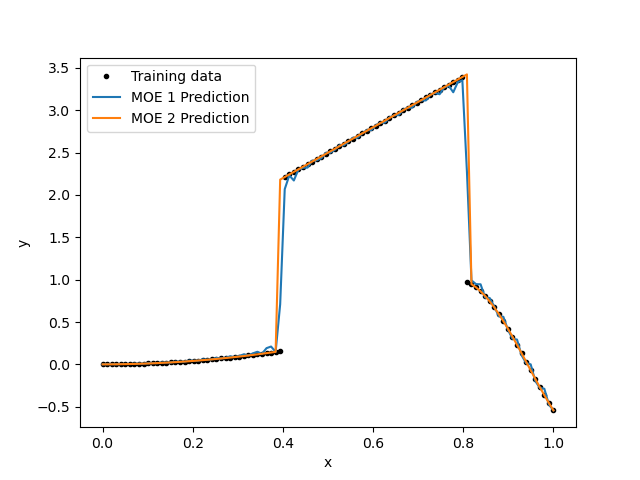
Example 1
import matplotlib.pyplot as plt
import numpy as np

from smt.applications import MOE
from smt.sampling_methods import FullFactorial

nt = 35

def function_test_1d(x):
    import numpy as np  # Note: only required by SMT doc testing toolchain

    x = np.reshape(x, (-1,))
    y = np.zeros(x.shape)
    y[x < 0.4] = x[x < 0.4] ** 2
    y[(x >= 0.4) & (x < 0.8)] = 3 * x[(x >= 0.4) & (x < 0.8)] + 1
    y[x >= 0.8] = np.sin(10 * x[x >= 0.8])
    return y.reshape((-1, 1))

x = np.linspace(0, 1, 100)
ytrue = function_test_1d(x)

# Training data
sampling = FullFactorial(xlimits=np.array([[0, 1]]), clip=True)
np.random.seed(0)
xt = sampling(nt)
yt = function_test_1d(xt)

# Mixture of experts
print("MOE Experts: ", MOE.AVAILABLE_EXPERTS)

# MOE1: Find the best surrogate model on the whole domain
moe1 = MOE(n_clusters=1)
print("MOE1 enabled experts: ", moe1.enabled_experts)
moe1.set_training_values(xt, yt)
moe1.train()
y_moe1 = moe1.predict_values(x)

# MOE2: Set nb of cluster with just KRG, LS and IDW surrogate models
moe2 = MOE(smooth_recombination=False, n_clusters=3, allow=["KRG", "LS", "IDW"])
print("MOE2 enabled experts: ", moe2.enabled_experts)
moe2.set_training_values(xt, yt)
moe2.train()
y_moe2 = moe2.predict_values(x)

fig, axs = plt.subplots(1)
axs.plot(x, ytrue, ".", color="black")
axs.plot(x, y_moe1)
axs.plot(x, y_moe2)
axs.set_xlabel("x")
axs.set_ylabel("y")
axs.legend(["Training data", "MOE 1 Prediction", "MOE 2 Prediction"])

plt.show()
MOE Experts:  ['KRG', 'KPLS', 'KPLSK', 'LS', 'QP', 'RBF', 'IDW', 'RMTB', 'RMTC']
MOE1 enabled experts:  ['KRG', 'LS', 'QP', 'KPLS', 'KPLSK', 'RBF', 'RMTC', 'RMTB', 'IDW']
Kriging 0.9987630403561562
LS 2.0995727775991893
QP 2.3107220698461353
KPLS 0.9987630403561562
KPLSK 1.0012308930753486
RBF 0.7122162322056577
RMTC 0.4528283974573165
RMTB 0.3597578645031203
IDW 0.12658286305366004
Best expert = IDW
MOE2 enabled experts:  ['KRG', 'LS', 'IDW']
Kriging 6.043625599971847e-08
LS 0.0
IDW 0.001825019437627251
Best expert = LS
Kriging 7.437040120341819e-07
LS 0.030866878506597206
IDW 0.00366740075240353
Best expert = Kriging
Kriging 3.884161129508179e-06
LS 0.07309199964574886
IDW 0.06980900375922339
Best expert = Kriging
Example 2
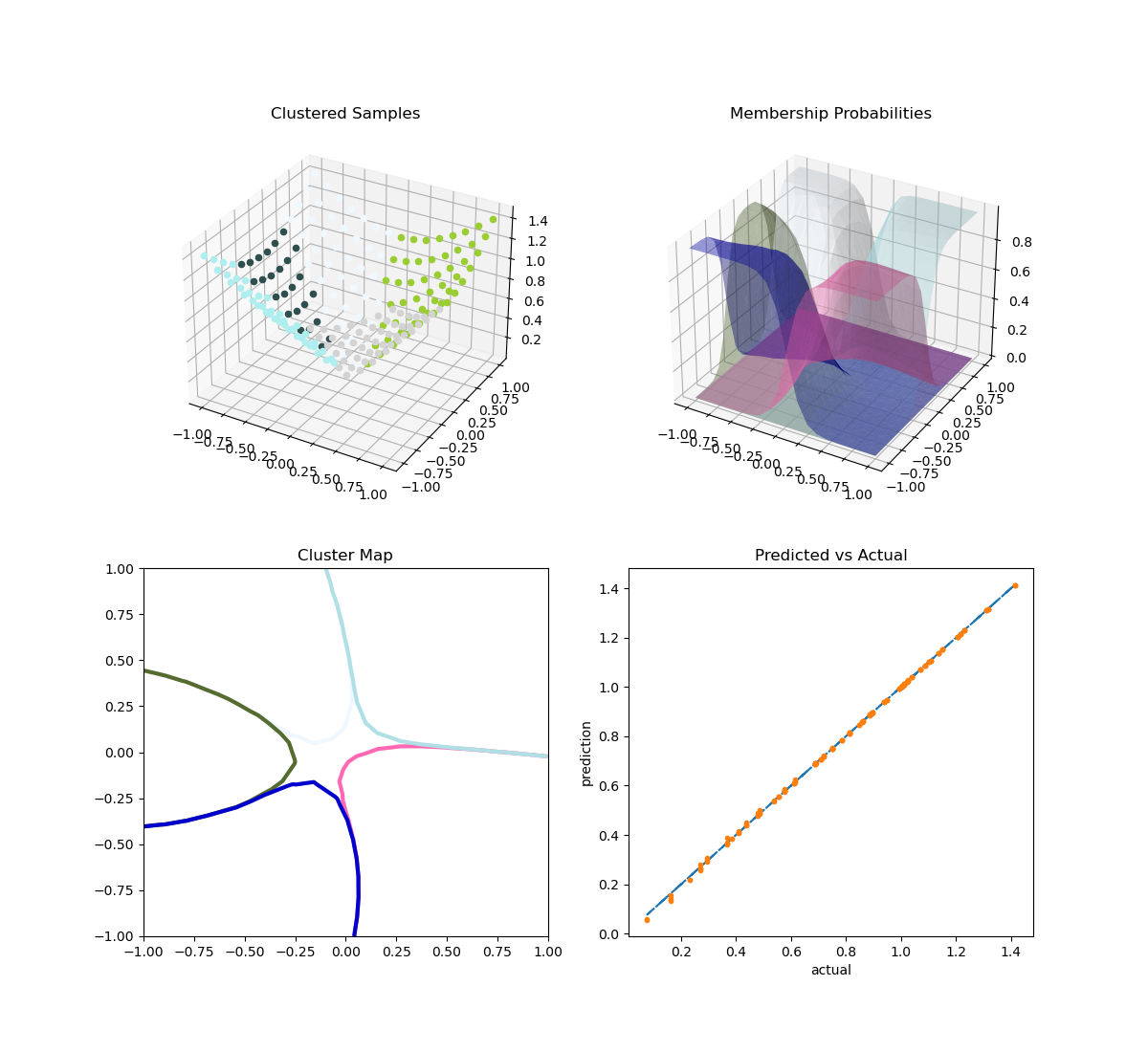
import matplotlib.pyplot as plt
import numpy as np
from matplotlib import colors

from smt.applications import MOE
from smt.problems import LpNorm
from smt.sampling_methods import FullFactorial

ndim = 2
nt = 200
ne = 200

# Problem: L1 norm (dimension 2)
prob = LpNorm(ndim=ndim)

# Training data
sampling = FullFactorial(xlimits=prob.xlimits, clip=True)
np.random.seed(0)
xt = sampling(nt)
yt = prob(xt)

# Mixture of experts
print("MOE Experts: ", MOE.AVAILABLE_EXPERTS)

moe = MOE(smooth_recombination=True, n_clusters=5, deny=["RMTB", "KPLSK"])
print("Enabled Experts: ", moe.enabled_experts)
moe.set_training_values(xt, yt)
moe.train()

# Validation data
np.random.seed(1)
xe = sampling(ne)
ye = prob(xe)

# Prediction
y = moe.predict_values(xe)
fig = plt.figure(1)
fig.set_size_inches(12, 11)

# Cluster display
colors_ = list(colors.cnames.items())
GMM = moe.cluster
weight = GMM.weights_
prob_ = moe._proba_cluster(xt)
sort = np.apply_along_axis(np.argmax, 1, prob_)

xlim = prob.xlimits
x0 = np.linspace(xlim[0, 0], xlim[0, 1], 20)
x1 = np.linspace(xlim[1, 0], xlim[1, 1], 20)
xv, yv = np.meshgrid(x0, x1)
x = np.array(list(zip(xv.reshape((-1,)), yv.reshape((-1,)))))
prob = moe._proba_cluster(x)

plt.subplot(221, projection="3d")
ax = plt.gca()
for i in range(len(sort)):
    color = colors_[int(((len(colors_) - 1) / sort.max()) * sort[i])][0]
    ax.scatter(xt[i][0], xt[i][1], yt[i], c=color)
plt.title("Clustered Samples")

plt.subplot(222, projection="3d")
ax = plt.gca()
for i in range(len(weight)):
    color = colors_[int(((len(colors_) - 1) / len(weight)) * i)][0]
    ax.plot_trisurf(
        x[:, 0], x[:, 1], prob[:, i], alpha=0.4, linewidth=0, color=color
    )
plt.title("Membership Probabilities")

plt.subplot(223)
for i in range(len(weight)):
    color = colors_[int(((len(colors_) - 1) / len(weight)) * i)][0]
    plt.tricontour(x[:, 0], x[:, 1], prob[:, i], 1, colors=color, linewidths=3)
plt.title("Cluster Map")

plt.subplot(224)
plt.plot(ye, ye, "-.")
plt.plot(ye, y, ".")
plt.xlabel("actual")
plt.ylabel("prediction")
plt.title("Predicted vs Actual")

plt.show()
MOE Experts:  ['KRG', 'KPLS', 'KPLSK', 'LS', 'QP', 'RBF', 'IDW', 'RMTB', 'RMTC']
Enabled Experts:  ['KRG', 'LS', 'QP', 'KPLS', 'RBF', 'RMTC', 'IDW']
Kriging 0.00015895631645361727
LS 0.10034642438446516
QP 0.016137577961415916
KPLS 0.00011789741082734461
RBF 0.00012095280757527556
RMTC 0.037425911363043046
IDW 0.10818152180292155
Best expert = KPLS
Kriging 0.0022109748332404763
LS 0.04486521104672596
QP 0.01718686849165099
KPLS 1.0366603369491654
RBF 0.002702825043847581
RMTC 0.03608811487443848
IDW 0.251498569974773
Best expert = Kriging
Kriging 0.0007803594230968192
LS 0.10048485269823051
QP 0.03288166570838189
KPLS 0.0007142319203370067
RBF 0.0008723440407746893
RMTC 0.02651638971374492
IDW 0.16722795244164632
Best expert = KPLS
Kriging 0.0004650593462218761
LS 0.07157076020656872
QP 0.022178388510381553
KPLS 0.0004223677176430306
RBF 0.000898889422414607
RMTC 0.026044435114639785
IDW 0.2372951327651174
Best expert = KPLS
Kriging 0.0027483622702309065
LS 0.2084314251325522
QP 0.048305669190244635
KPLS 0.0016596529522717078
RBF 0.0017776814331127986
RMTC 0.022686967022889047
IDW 0.2411367680083784
Best expert = KPLS
Options
Option |
Default |
Acceptable values |
Acceptable types |
Description |
|---|---|---|---|---|
xt |
None |
None |
[‘ndarray’] |
Training inputs |
yt |
None |
None |
[‘ndarray’] |
Training outputs |
ct |
None |
None |
[‘ndarray’] |
Training derivative outputs used for clustering |
xtest |
None |
None |
[‘ndarray’] |
Test inputs |
ytest |
None |
None |
[‘ndarray’] |
Test outputs |
ctest |
None |
None |
[‘ndarray’] |
Derivatives test outputs used for clustering |
n_clusters |
2 |
None |
[‘int’] |
Number of clusters |
smooth_recombination |
True |
None |
[‘bool’] |
Continuous cluster transition |
heaviside_optimization |
False |
None |
[‘bool’] |
Optimize Heaviside scaling factor when smooth recombination is used |
derivatives_support |
False |
None |
[‘bool’] |
Use only experts that support derivatives prediction |
variances_support |
False |
None |
[‘bool’] |
Use only experts that support variance prediction |
allow |
[] |
None |
None |
Names of allowed experts to be possibly part of the mixture. Empty list corresponds to all surrogates allowed. |
deny |
[] |
None |
None |
Names of forbidden experts |