Mixed Integer and Hierarchical Design Spaces (Variables, Sampling and Context)
Mixed-discrete surrogate models need detailed information about the behavior of the design space (the input space),
which you can specify using the design_space module. The design space definition module also supports specifying
design space hierarchy including conditionally active design variables.
Design variables types
The following variable types are supported:
Float: the variable can assume any real/continuous value between two bounds (inclusive)
Integer: the variable can assume any integer value between two bounds (inclusive)
Ordinal: the variable can assume any value from some set, order is relevant
Categorical: the variable can assume any value from some set, order is not relevant
Integer, ordinal and categorical variables are all discrete variables, as they can only assume specific values from some set. The main differences between these types is the question whether distance and whether ordering matters:
Integer: distance and order matters, e.g. the number of engines on an aircraft
Ordinal: only order matters, e.g. steps in a process
Categorical: neither distance nor order matters, e.g. different means for providing some functionality
More details can be found in [1] .
Variables are specified using the DesignVariable classes in smt.utils.design_space:
- FloatVariable(lower_bound, upper_bound), upper should be greater than lower bound
- IntegerVariable(lower_bound, upper_bound), bounds should be integers
- OrdinalVariable(values), values is a list of int, float or str, encoded as integers from 0 to len(values)-1
- CategoricalVariable(values), same specification and encoding as ordinal
The design space is then defined from a list of design variables and implements sampling and correction interfaces:
import numpy as np

from smt.applications.mixed_integer import MixedIntegerSamplingMethod
from smt.sampling_methods import LHS
from smt.design_space import (
    CategoricalVariable,
    DesignSpace,
    FloatVariable,
    IntegerVariable,
    OrdinalVariable,
)

ds = DesignSpace(
    [
        CategoricalVariable(
            ["A", "B"]
        ),  # x0 categorical: A or B; order is not relevant
        OrdinalVariable(
            ["C", "D", "E"]
        ),  # x1 ordinal: C, D or E; order is relevant
        IntegerVariable(
            0, 2
        ),  # x2 integer between 0 and 2 (inclusive): 0, 1, 2
        FloatVariable(0, 1),  # c3 continuous between 0 and 1
    ]
)

# Sample the design space
# Note: is_acting_sampled specifies for each design variable whether it is acting or not
ds.seed = 42
samp = MixedIntegerSamplingMethod(
    LHS, ds, criterion="ese", random_state=ds.seed
)
x_sampled, is_acting_sampled = samp(100, return_is_acting=True)

# Correct design vectors: round discrete variables, correct hierarchical variables
x_corr, is_acting = ds.correct_get_acting(
    np.array(
        [
            [0, 0, 2, 0.25],
            [0, 2, 1, 0.75],
        ]
    )
)
print(is_acting)
[[ True  True  True  True]
 [ True  True  True  True]]
Hierarchical variables
The design space definition uses the framework of [2] to manage both mixed-discrete variables and hierarchical variables. We distinguish dimensional (or meta) variables which are a special type of variables that may affect the dimension of the problem and decide if some other decreed variables are acting or non-acting.
Additionally, it is also possible to define value constraints that explicitly forbid two variables from having some values simultaneously or for a continuous variable to be greater than another. This can be useful for modeling incompatibility relationships: for example, engines can’t be installed on the back of the fuselage (vs on the wings) if a normal tail (vs T-tail) is selected.
Note: this feature is only available if smt_design_space_ext has been installed: pip install smt-design-space-ext
The hierarchy relationships are specified after instantiating the design space:
import numpy as np

from smt.applications.mixed_integer import (
    MixedIntegerKrigingModel,
    MixedIntegerSamplingMethod,
)
from smt.sampling_methods import LHS
from smt.surrogate_models import KRG, MixHrcKernelType, MixIntKernelType
from smt.design_space import (
    CategoricalVariable,
    FloatVariable,
    IntegerVariable,
    OrdinalVariable,
)
from smt_design_space_ext import ConfigSpaceDesignSpaceImpl

ds = ConfigSpaceDesignSpaceImpl(
    [
        CategoricalVariable(
            ["A", "B"]
        ),  # x0 categorical: A or B; order is not relevant
        OrdinalVariable(
            ["C", "D", "E"]
        ),  # x1 ordinal: C, D or E; order is relevant
        IntegerVariable(
            0, 2
        ),  # x2 integer between 0 and 2 (inclusive): 0, 1, 2
        FloatVariable(0, 1),  # c3 continuous between 0 and 1
    ]
)

# Declare that x1 is acting if x0 == A
ds.declare_decreed_var(decreed_var=1, meta_var=0, meta_value="A")

# Nested hierarchy is possible: activate x2 if x1 == C or D
# Note: only if ConfigSpace is installed! pip install smt[cs]
ds.declare_decreed_var(decreed_var=2, meta_var=1, meta_value=["C", "D"])

# It is also possible to explicitly forbid two values from occurring simultaneously
# Note: only if ConfigSpace is installed! pip install smt[cs]
ds.add_value_constraint(
    var1=0, value1="A", var2=2, value2=[0, 1]
)  # Forbid x0 == A && x2 == 0 or 1

# For quantitative variables, it is possible to specify order relation
ds.add_value_constraint(
    var1=2, value1="<", var2=3, value2=">"
)  # Prevent x2 < x3

# Sample the design space
# Note: is_acting_sampled specifies for each design variable whether it is acting or not
ds.seed = 42
samp = MixedIntegerSamplingMethod(
    LHS, ds, criterion="ese", random_state=ds.seed
)
Xt, is_acting_sampled = samp(100, return_is_acting=True)

rng = np.random.default_rng(42)
Yt = 4 * rng.random(100) - 2 + Xt[:, 0] + Xt[:, 1] - Xt[:, 2] - Xt[:, 3]
# Correct design vectors: round discrete variables, correct hierarchical variables
x_corr, is_acting = ds.correct_get_acting(
    np.array(
        [
            [0, 0, 2, 0.25],
            [0, 2, 1, 0.75],
            [1, 2, 1, 0.66],
        ]
    )
)

# Observe the hierarchical behavior:
assert np.all(
    is_acting
    == np.array(
        [
            [True, True, True, True],
            [
                True,
                True,
                False,
                True,
            ],  # x2 is not acting if x1 != C or D (0 or 1)
            [
                True,
                False,
                False,
                True,
            ],  # x1 is not acting if x0 != A, and x2 is not acting because x1 is not acting
        ]
    )
)
assert np.all(
    x_corr
    == np.array(
        [
            [0, 0, 2, 0.25],
            [0, 2, 0, 0.75],
            # x2 is not acting, so it is corrected ("imputed") to its non-acting value (0 for discrete vars)
            [1, 0, 0, 0.66],  # x1 and x2 are imputed
        ]
    )
)

sm = MixedIntegerKrigingModel(
    surrogate=KRG(
        design_space=ds,
        categorical_kernel=MixIntKernelType.HOMO_HSPHERE,
        hierarchical_kernel=MixHrcKernelType.ALG_KERNEL,
        theta0=[1e-2],
        hyper_opt="Cobyla",
        corr="abs_exp",
        n_start=5,
    ),
)
sm.set_training_values(Xt, Yt)
sm.train()
y_s = sm.predict_values(Xt)[:, 0]
pred_RMSE = np.linalg.norm(y_s - Yt) / len(Yt)

y_sv = sm.predict_variances(Xt)[:, 0]
_var_RMSE = np.linalg.norm(y_sv) / len(Yt)
assert pred_RMSE < 1e-7
print("Pred_RMSE", pred_RMSE)

self._sm = sm  # to be ignored: just used for automated test
___________________________________________________________________________

                            MixedIntegerKriging
___________________________________________________________________________

 Problem size

      # training points.        : 100

___________________________________________________________________________

 Training

   Training ...
   Training - done. Time (sec):  2.9558113
___________________________________________________________________________

 Evaluation

      # eval points. : 100

   Predicting ...
   Predicting - done. Time (sec):  0.2929027

   Prediction time/pt. (sec) :  0.0029290

Pred_RMSE 4.0000324624835547e-13
Design space and variable class references
The DesignSpace class and design variable classes implement the relevant functionality.
Example of sampling a mixed-discrete design space
import matplotlib.pyplot as plt
import numpy as np
from matplotlib import colors

from smt.applications.mixed_integer import MixedIntegerSamplingMethod
from smt.sampling_methods import LHS
from smt.design_space import (
    FloatVariable,
    DesignSpace,
    CategoricalVariable,
)

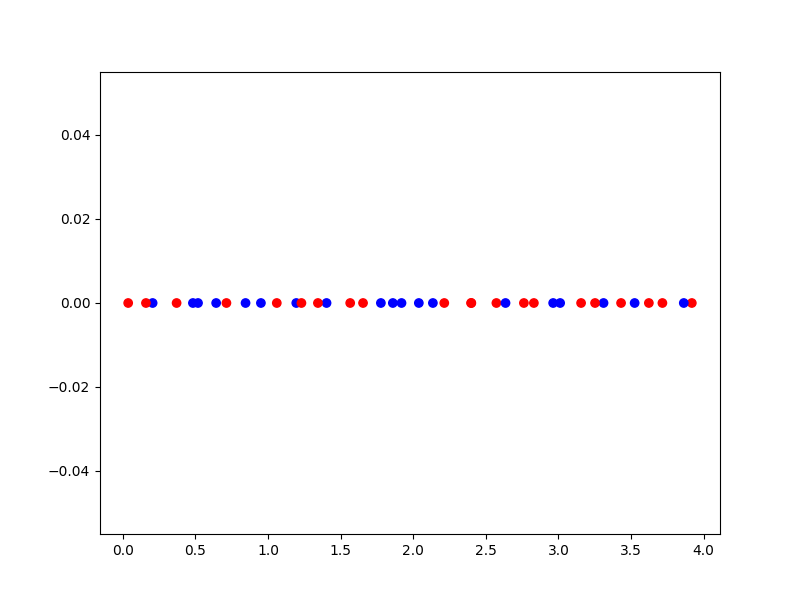
float_var = FloatVariable(0, 4)
cat_var = CategoricalVariable(["blue", "red"])

design_space = DesignSpace(
    [
        float_var,
        cat_var,
    ]
)

num = 40
design_space.seed = 42
samp = MixedIntegerSamplingMethod(
    LHS, design_space, criterion="ese", random_state=design_space.seed
)
x, x_is_acting = samp(num, return_is_acting=True)

cmap = colors.ListedColormap(cat_var.values)
plt.scatter(x[:, 0], np.zeros(num), c=x[:, 1], cmap=cmap)
plt.show()
Mixed integer context
The MixedIntegerContext class helps the user to use mixed integer sampling methods and surrogate models consistently
by acting as a factory for those objects given a x specification: (xtypes, xlimits).
- class smt.applications.mixed_integer.MixedIntegerContext(design_space, work_in_folded_space=True)[source]
Class which acts as sampling method and surrogate model factory to handle integer and categorical variables consistently.
- Attributes:
- design_space
Methods
build_kriging_model(surrogate)Build MixedIntegerKrigingModel from given SMT surrogate model.
build_sampling_method([random_state])Build Mixed Integer LHS ESE sampler.
build_surrogate_model(surrogate)Build MixedIntegerKrigingModel from given SMT surrogate model.
get_unfolded_dimension()Returns x dimension (int) taking into account unfolded categorical features
get_unfolded_xlimits()Returns relaxed xlimits Each level of an enumerate gives a new continuous dimension in [0, 1].
- MixedIntegerContext.__init__(design_space, work_in_folded_space=True)[source]
- Parameters:
- design_space: BaseDesignSpace
the design space definition (includes mixed-discrete and/or hierarchical specifications)
- work_in_folded_space: bool
whether x data are in given in folded space (enum indexes) or not (enum masks)
Example of mixed integer context usage
import matplotlib.pyplot as plt

from smt.applications.mixed_integer import MixedIntegerContext
from smt.surrogate_models import KRG
from smt.design_space import (
    CategoricalVariable,
    DesignSpace,
    FloatVariable,
    IntegerVariable,
)

design_space = DesignSpace(
    [
        IntegerVariable(0, 5),
        FloatVariable(0.0, 4.0),
        CategoricalVariable(["blue", "red", "green", "yellow"]),
    ]
)

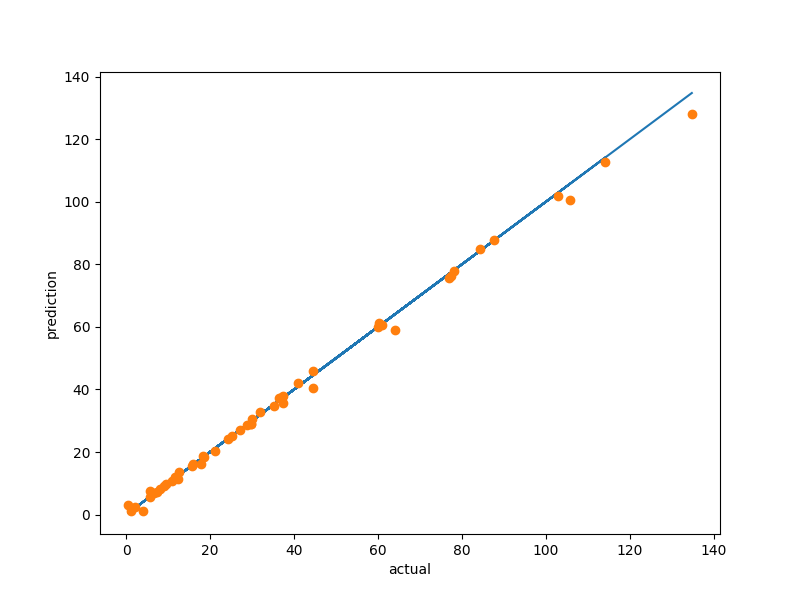
def ftest(x):
    return (x[:, 0] * x[:, 0] + x[:, 1] * x[:, 1]) * (x[:, 2] + 1)

# Helper class for creating surrogate models
mi_context = MixedIntegerContext(design_space)

# DOE for training
sampler = mi_context.build_sampling_method()

num = mi_context.get_unfolded_dimension() * 5
print("DOE point nb = {}".format(num))
xt = sampler(num)
yt = ftest(xt)

# Surrogate
sm = mi_context.build_kriging_model(KRG(hyper_opt="Cobyla"))
sm.set_training_values(xt, yt)
sm.train()

# DOE for validation
xv = sampler(50)
yv = ftest(xv)
yp = sm.predict_values(xv)

plt.plot(yv, yv)
plt.plot(yv, yp, "o")
plt.xlabel("actual")
plt.ylabel("prediction")

plt.show()
DOE point nb = 30
___________________________________________________________________________

                            MixedIntegerKriging
___________________________________________________________________________

 Problem size

      # training points.        : 30

___________________________________________________________________________

 Training

   Training ...
   Training - done. Time (sec):  0.4647245
___________________________________________________________________________

 Evaluation

      # eval points. : 50

   Predicting ...
   Predicting - done. Time (sec):  0.0116608

   Prediction time/pt. (sec) :  0.0002332