Multi-Fidelity Co-Kriging (MFCK)
MFCK is a multi-fidelity modeling method similar to MFK which uses an autoregressive model of order 1 (AR1).
where \(\rho(x)\) is a scaling/correlation factor (constant for MFCK) and \(\delta(\cdot)\) is a discrepancy function.
The additive AR1 formulation was first introduced by Kennedy and O’Hagan [1]. While MFK follows the recursive formulation of Le Gratiet [2]. MFCK uses ab block-wise matrix construction for \(n\) levels of fidelity offering freedom in terms of data input assumptions.
References
Usage
import matplotlib.pyplot as plt
import numpy as np

from smt.applications.mfck import MFCK
from smt.sampling_methods import LHS

# low fidelity model
def lf_function(x):
    import numpy as np

    return (
        0.5 * ((x * 6 - 2) ** 2) * np.sin((x * 6 - 2) * 2)
        + (x - 0.5) * 10.0
        - 5
    )

    # high fidelity model

def hf_function(x):
    import numpy as np

    return ((x * 6 - 2) ** 2) * np.sin((x * 6 - 2) * 2)

# Problem set up
xlimits = np.array([[0.0, 1.0]])

# Example with non-nested input data
Obs_HF = 7  # Number of observations of HF
Obs_LF = 14  # Number of observations of LF

# Creation of LHS for non-nested LF data
sampling = LHS(
    xlimits=xlimits,
    criterion="ese",
)

xt_e_non = sampling(Obs_HF)
xt_c_non = sampling(Obs_LF)

# Evaluate the LF function
yt_e_non = hf_function(xt_e_non)
yt_c_non = lf_function(xt_c_non)

sm_non_nested = MFCK(
    theta0=xt_e_non.shape[1] * [0.5],
    theta_bounds=[1e-2, 100],
    corr="squar_exp",
    eval_noise=False,
)
sm_non_nested.options["lambda"] = 0.0  # Without regularization

# low-fidelity dataset names being integers from 0 to level-1
sm_non_nested.set_training_values(xt_c_non, yt_c_non, name=0)
# high-fidelity dataset without name
sm_non_nested.set_training_values(xt_e_non, yt_e_non)

# train the model
sm_non_nested.train()

x = np.linspace(0, 1, 101, endpoint=True).reshape(-1, 1)

m_non_nested, c_non_nested = sm_non_nested.predict_all_levels(x)

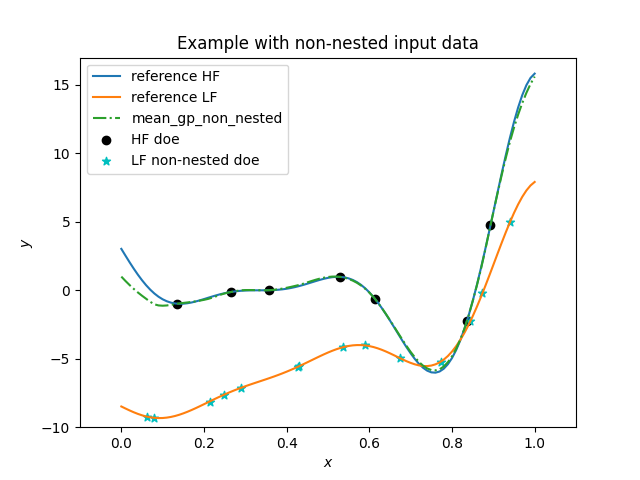
plt.figure()
plt.title("Example with non-nested input data")
plt.plot(x, hf_function(x), label="reference HF")
plt.plot(x, lf_function(x), label="reference LF")
plt.plot(x, m_non_nested[1], linestyle="-.", label="mean_gp_non_nested")
plt.scatter(xt_e_non, yt_e_non, marker="o", color="k", label="HF doe")
plt.scatter(
    xt_c_non, yt_c_non, marker="*", color="c", label="LF non-nested doe"
)

plt.legend(loc=0)
plt.ylim(-10, 17)
plt.xlim(-0.1, 1.1)
plt.xlabel(r"$x$")
plt.ylabel(r"$y$")

plt.show()
Options
Option |
Default |
Acceptable values |
Acceptable types |
Description |
|---|---|---|---|---|
print_global |
True |
None |
[‘bool’] |
Global print toggle. If False, all printing is suppressed |
print_training |
True |
None |
[‘bool’] |
Whether to print training information |
print_prediction |
True |
None |
[‘bool’] |
Whether to print prediction information |
print_problem |
True |
None |
[‘bool’] |
Whether to print problem information |
print_solver |
True |
None |
[‘bool’] |
Whether to print solver information |
poly |
constant |
[‘constant’, ‘linear’, ‘quadratic’] |
[‘str’] |
Regression function type |
corr |
squar_exp |
[‘pow_exp’, ‘abs_exp’, ‘squar_exp’, ‘matern52’, ‘matern32’] |
[‘str’, ‘Kernel’] |
Correlation function type |
pow_exp_power |
1.9 |
None |
[‘float’] |
Power for the pow_exp kernel function (valid values in (0.0, 2.0]). This option is set automatically when corr option is squar, abs, or matern. |
categorical_kernel |
MixIntKernelType.CONT_RELAX |
[<MixIntKernelType.CONT_RELAX: ‘CONT_RELAX’>, <MixIntKernelType.GOWER: ‘GOWER’>, <MixIntKernelType.EXP_HOMO_HSPHERE: ‘EXP_HOMO_HSPHERE’>, <MixIntKernelType.HOMO_HSPHERE: ‘HOMO_HSPHERE’>, <MixIntKernelType.COMPOUND_SYMMETRY: ‘COMPOUND_SYMMETRY’>, <MixIntKernelType.DIST_ENCODING: ‘DIST_ENCODING’>] |
None |
The kernel to use for categorical inputs. Only for non continuous Kriging |
categorical_kernel_beta |
1.0 |
None |
[‘float’, ‘int’] |
Power for the distributional encoding kernel (valid values in (0.0, 2.0]). |
hierarchical_kernel |
MixHrcKernelType.ALG_KERNEL |
[<MixHrcKernelType.ALG_KERNEL: ‘ALG_KERNEL’>, <MixHrcKernelType.ARC_KERNEL: ‘ARC_KERNEL’>] |
None |
The kernel to use for mixed hierarchical inputs. Only for non continuous Kriging |
nugget |
2.220446049250313e-14 |
None |
[‘float’] |
a jitter for numerical stability |
theta0 |
[0.01] |
None |
[‘list’, ‘ndarray’] |
Initial hyperparameters |
theta_bounds |
[1e-06, 20.0] |
None |
[‘list’, ‘ndarray’] |
bounds for hyperparameters |
hyper_opt |
Cobyla-nlopt |
[‘Cobyla’, ‘Cobyla-nlopt’] |
None |
Optimiser for hyperparameters optimisation |
eval_noise |
False |
[True, False] |
[‘bool’] |
noise evaluation flag |
noise0 |
[0.0] |
None |
[‘list’, ‘ndarray’] |
Initial noise hyperparameters |
noise_bounds |
[np.float64(2.220446049250313e-14), 10000000000.0] |
None |
[‘list’, ‘ndarray’] |
bounds for noise hyperparameters |
use_het_noise |
False |
[True, False] |
[‘bool’] |
heteroscedastic noise evaluation flag |
n_start |
10 |
None |
[‘int’] |
number of optimizer runs (multistart method) |
xlimits |
None |
None |
[‘list’, ‘ndarray’] |
definition of a design space of float (continuous) variables: array-like of size nx x 2 (lower, upper bounds) |
design_space |
None |
None |
[‘BaseDesignSpace’, ‘list’, ‘ndarray’] |
definition of the (hierarchical) design space: use smt.design_space.DesignSpace as the main API. Also accepts list of float variable bounds |
is_ri |
False |
None |
[‘bool’] |
activate reinterpolation for noisy cases |
seed |
41 |
None |
[‘NoneType’, ‘int’, ‘Generator’] |
Numpy Generator object or seed number which controls random draws for internal optim (set by default to get reproductibility) |
rho0 |
2.0 |
None |
[‘float’] |
Initial rho for the autoregressive model , (scalar factor between two consecutive fidelities, e.g., Y_HF = (Rho) * Y_LF + Gamma |
rho_bounds |
[-5, 5] |
None |
[‘list’, ‘ndarray’] |
Bounds for the rho parameter used in the autoregressive model |
sigma0 |
1.0 |
None |
[‘float’] |
Initial variance parameter |
sigma_bounds |
[0.1, 100] |
None |
[‘list’, ‘ndarray’] |
Bounds for the variance parameter |
lambda |
0.0 |
None |
[‘float’] |
Regularization parameter |