Sparse Multi-Fidelity Co-Kriging (SMFCK)
SMFCK is a multi-fidelity modeling method adding sparsity to the MFCK model. This model allows to add sparsity to all the fidelity levels.
We follow the same autoregressive formulation:
where \(\rho(x)\) is a scaling/correlation factor (constant for MFCK) and \(\delta(\cdot)\) is a discrepancy function.
The additive AR1 formulation was first introduced by Kennedy and O’Hagan [1]. While MFK follows the recursive formulation of Le Gratiet [2]. SMFCK uses ab block-wise matrix construction for \(n\) levels of fidelity offering freedom in terms of data input assumptions. The sparse approximations are based on the formulations of Titsias [3] and given in [4].
References
Usage
import matplotlib.pyplot as plt
import numpy as np
from smt.sampling_methods import LHS  # noqa
from smt.applications import SMFCK

# low fidelity model
def lf_function(x):
    import numpy as np

    return (
        0.5 * ((x * 6 - 2) ** 2) * np.sin((x * 6 - 2) * 2)
        + (x - 0.5) * 10.0
        - 5
    )

# high fidelity model
def hf_function(x):
    import numpy as np

    return ((x * 6 - 2) ** 2) * np.sin((x * 6 - 2) * 2)

# Problem set up
xlimits = np.array([[0.0, 1.0]])
# Example with non-nested input data
Obs_HF = 7  # Number of observations of HF
Obs_LF = 14  # Number of observations of LF

# Creation of LHS for non-nested LF data
sampling = LHS(
    xlimits=xlimits,
    criterion="ese",
    seed=0,
)

xt_e_non = sampling(Obs_HF)
xt_c_non = sampling(Obs_LF)

# Evaluate the HF and LF functions
yt_e = hf_function(xt_e_non)
yt_c = lf_function(xt_c_non)

sm = SMFCK(
    hyper_opt="Cobyla",
    theta0=xt_e_non.shape[1] * [1.0],
    theta_bounds=[1e-6, 2.0],
    print_global=False,
    method="FITC",
    eval_noise=True,
    noise0=[1e-5],
    noise_bounds=np.array((1e-12, 10.0)),
    corr="squar_exp",
    n_inducing=[xt_c_non.shape[0] - 2, xt_e_non.shape[0] - 1],
)

# low-fidelity dataset names being integers from 0 to level-1
sm.set_training_values(xt_c_non, yt_c, name=0)
# high-fidelity dataset without name
sm.set_training_values(xt_e_non, yt_e)

# train the model
sm.train()

x = np.linspace(0, 1, 101, endpoint=True).reshape(-1, 1)

# query the outputs

mean, cov = sm.predict_all_levels(x)

y = mean[-1]
# _derivs = sm.predict_derivatives(x, kx=0)

plt.figure()

plt.plot(x, hf_function(x), label="reference")
plt.plot(x, y, linestyle="-.", label="mean_gp")
plt.scatter(xt_e_non, yt_e, marker="o", color="k", label="HF doe")
plt.scatter(xt_c_non, yt_c, marker="*", color="g", label="LF doe")
plt.plot(
    sm.Z[0],
    -9.9 * np.ones_like(sm.Z[0]),
    "g|",
    mew=2,
    label=f"LF inducing:{sm.Z[0].shape[0]}",
)
plt.plot(
    sm.Z[1],
    -9.9 * np.ones_like(sm.Z[1]),
    "k|",
    mew=2,
    label=f"HF inducing:{sm.Z[1].shape[0]}",
)

plt.legend(loc=0)
plt.ylim(-10, 17)
plt.xlim(-0.1, 1.1)
plt.xlabel(r"$x$")
plt.ylabel(r"$y$")

plt.show()
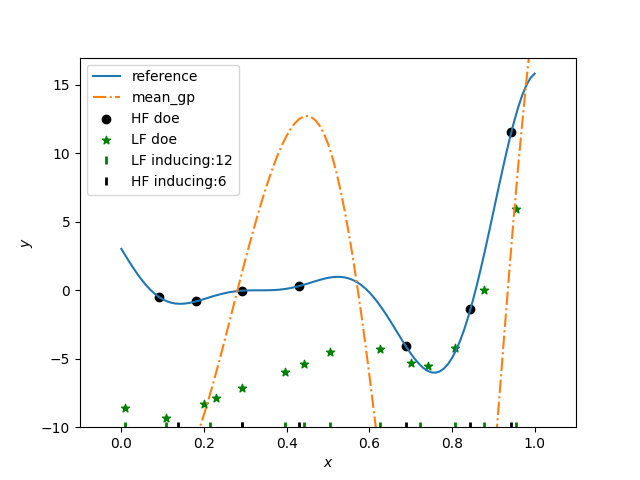
Options
Option |
Default |
Acceptable values |
Acceptable types |
Description |
|---|---|---|---|---|
print_global |
True |
None |
[‘bool’] |
Global print toggle. If False, all printing is suppressed |
print_training |
True |
None |
[‘bool’] |
Whether to print training information |
print_prediction |
True |
None |
[‘bool’] |
Whether to print prediction information |
print_problem |
True |
None |
[‘bool’] |
Whether to print problem information |
print_solver |
True |
None |
[‘bool’] |
Whether to print solver information |
poly |
constant |
[‘constant’, ‘linear’, ‘quadratic’] |
[‘str’] |
Regression function type |
corr |
squar_exp |
[‘pow_exp’, ‘abs_exp’, ‘squar_exp’, ‘matern52’, ‘matern32’] |
[‘str’, ‘Kernel’] |
Correlation function type |
pow_exp_power |
1.9 |
None |
[‘float’] |
Power for the pow_exp kernel function (valid values in (0.0, 2.0]). This option is set automatically when corr option is squar, abs, or matern. |
categorical_kernel |
MixIntKernelType.CONT_RELAX |
[<MixIntKernelType.CONT_RELAX: ‘CONT_RELAX’>, <MixIntKernelType.GOWER: ‘GOWER’>, <MixIntKernelType.EXP_HOMO_HSPHERE: ‘EXP_HOMO_HSPHERE’>, <MixIntKernelType.HOMO_HSPHERE: ‘HOMO_HSPHERE’>, <MixIntKernelType.COMPOUND_SYMMETRY: ‘COMPOUND_SYMMETRY’>, <MixIntKernelType.DIST_ENCODING: ‘DIST_ENCODING’>] |
None |
The kernel to use for categorical inputs. Only for non continuous Kriging |
categorical_kernel_beta |
1.0 |
None |
[‘float’, ‘int’] |
Power for the distributional encoding kernel (valid values in (0.0, 2.0]). |
hierarchical_kernel |
MixHrcKernelType.ALG_KERNEL |
[<MixHrcKernelType.ALG_KERNEL: ‘ALG_KERNEL’>, <MixHrcKernelType.ARC_KERNEL: ‘ARC_KERNEL’>] |
None |
The kernel to use for mixed hierarchical inputs. Only for non continuous Kriging |
nugget |
2.220446049250313e-13 |
None |
[‘float’] |
a jitter for numerical stability |
theta0 |
[0.01] |
None |
[‘list’, ‘ndarray’] |
Initial hyperparameters |
theta_bounds |
[1e-06, 20.0] |
None |
[‘list’, ‘ndarray’] |
bounds for hyperparameters |
hyper_opt |
Cobyla |
[‘Cobyla’, ‘Cobyla-nlopt’] |
None |
Optimiser for hyperparameters optimisation |
eval_noise |
False |
[True, False] |
[‘bool’] |
If True, the model evaluates noise variance, can be homoscedastic or heteroscedastic |
noise0 |
[0.0] |
None |
[‘list’, ‘ndarray’] |
Initial noise hyperparameters |
noise_bounds |
[np.float64(2.220446049250313e-14), 10000000000.0] |
None |
[‘list’, ‘ndarray’] |
bounds for noise hyperparameters |
use_het_noise |
False |
[True, False] |
[‘bool’] |
If True, the model considers Heteroscedastic noise, array with the same size of y(x) is expected |
n_start |
10 |
None |
[‘int’] |
number of optimizer runs (multistart method) |
xlimits |
None |
None |
[‘list’, ‘ndarray’] |
definition of a design space of float (continuous) variables: array-like of size nx x 2 (lower, upper bounds) |
design_space |
None |
None |
[‘BaseDesignSpace’, ‘list’, ‘ndarray’] |
definition of the (hierarchical) design space: use smt.design_space.DesignSpace as the main API. Also accepts list of float variable bounds |
is_ri |
False |
None |
[‘bool’] |
activate reinterpolation for noisy cases |
seed |
0 |
None |
[‘NoneType’, ‘int’] |
seed number which controls random draws |
predict_with_noise |
False |
[True, False] |
[‘bool’] |
if use_het_noise is true, then the prediction of the noise variance over the test set will given |
rho0 |
1.0 |
None |
[‘float’] |
Initial rho for the autoregressive model , (scalar factor between two consecutive fidelities, e.g., Y_HF = (Rho) * Y_LF + Gamma |
rho_bounds |
[-5.0, 5.0] |
None |
[‘list’, ‘ndarray’] |
Bounds for the rho parameter used in the autoregressive model |
sigma0 |
1.0 |
None |
[‘float’] |
Initial variance parameter |
sigma_bounds |
[1e-06, 100] |
None |
[‘list’, ‘ndarray’] |
Bounds for the variance parameter |
lambda |
0.0 |
None |
[‘float’] |
Regularization parameter |
n_inducing |
[6, 5] |
None |
[‘list’, ‘ndarray’] |
Number of inducing points per fidelity level |
method |
FITC |
[‘FITC’] |
[‘str’] |
Methods available for Sparse Multi-fidelity |
inducing_method |
kmeans |
[‘random’, ‘kmeans’] |
[‘str’] |
The chosen method to induce points |